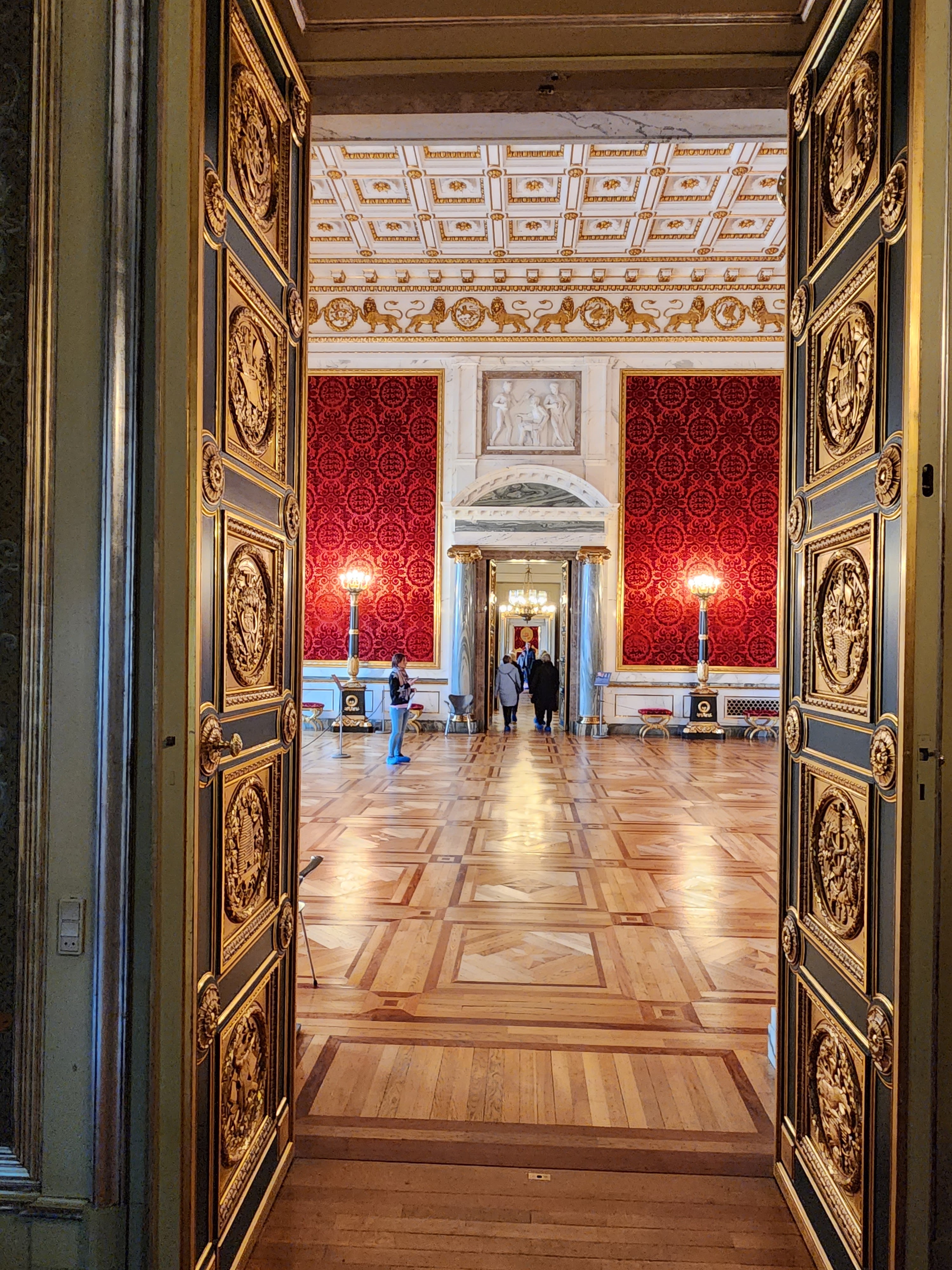
Have visited the Royal Reception Rooms in Christiansborg Palace (Danish: Christiansburg Slot; ⭐⭐) on a winter rainy day. There are total 19 rooms and each room has its specific functions. For example, the Green room next to the Great Hall is a back-stage area used by journalists or musicians to report or perform in special events.
The Royal Reception Rooms at Christiansborg Palace[1]are located on the ground floor and first floor in the northern half of the palace. The Rooms are used for official functions of the monarch such as banquets, state dinners, the New Year's levée, diplomatic accreditations, audiences and meetings of the council of state.
The Reception Rooms are richly adorned withfurniture and works of art, as well as decorations by some of the best Danish artists, such as Nikolaj Abraham Abildgaard, Christoffer Wilhelm Eckersberg, Laurits Tuxen, Joakim Skovgaard and Bjørn Nørgaard.
The most magnificent room belongs to the Great Hall where banquets were set up for special visitors and royal family.
The Great Hall is the largest and most spectacular of the Royal Reception Rooms. The Hall is 40 meters long with a ceiling height of 10 meters, and a gallery runs all the way around the room. The Hall seats 400 guests and is used for banquets, state dinners and receptions.
When you visit Royal Reception Rooms, don't forget to download the audio guide from Useeum to your phone and listen to it during the visit.
Photo Gallery
The below photos were taken on 03/21/2023.
Margrethe II (i.e., Queen of Denmark) and her family
Christian VIII
Queen Caroline Amalie
The King's Staircase
The Throne Room
The Queen receives kings, presidents and ambassadors in the Throne Room, whenever there are state visits, gala dinners or New Year banquets at the palace.
The Ceiling of Throne Room
Fredensborg Hall
Christian IX's six children with Queen Louise married into other European royal families, earning him the sobriquet "the father-in-law of Europe". It was for a while a tradition for them to gather at Fredensborg Palace some time during the summer, bringing their spouses and numerous offspring. These summer days spent together were known as the "Fredensborg days".
The Family of Christian IX of Denmark is a monumental oil on canvas group portrait painting by Laurits Tuxen of Christian IX of Denmark and his family of European royalty. The painting is on display in Fredensborg Hall.[2]
Laurits Tuxen's painting of King Christian IX and his whole family together at Fredensborg Palace
King Christian IX's Room
This room is used as an extension of the Throne room at events such as Ambassador reception.
Christian IX receiving King Geroge I of Greece at Fredensborg Palace (Artist: August Jerndorff)
Christian X riding across the former border in 1920 (Artist: Heinrich Dohm)
The Green Room
The Green Room is a back-stage area used by journalists or musicians to report or perform in special events.
The dinning hall was originally meant to host gala dinner. However, due to the width of table, it proves difficult to have a conversation across the big table. Today this room acts as a pantry room—a place to arrange the food arriving from an off-site kitchen.
The Alexander Hall
The room is named after Bertel Thorvaldsen's marble frieze which frames the hall under the ceiling.
Today, the Alexander Room provides the setting for small dinners, lunches, receptions and visits by members of the Danish Armed Forces during the New Year levee. In the jumble of mosaics, gold, mirrors and pillars, the hall echoes with chatter, laughter and clinking of coffee cups when the Armed Forces wait to wish the Queen a Happy New Year.
Miscellaneous
Street view of the Palace
Outside view of the Palace
Royal Reception Rooms in Christiansborg Palace (YouTube link)
TL;DR: T‑10 is gone — Barcelona now uses the T‑mobilitat system. The best tourist ticket is the T‑Casual (10 rides, Zone 1), but it does not cover the Airport Metro (L9 Sud) or the Aerobús. If you land at T1, skip buying transit tickets at the airport and take the Aerobús into the city first. Once you reach the city center and drop your bags, buy your T‑Casual from any Metro station vending machine and start using it for all your Barcelona travel. How to Buy and Use Barcelona's NEW Contactless Transport Cards (YouTube link) Barcelona has officially retired the old T‑10 paper ticket . Since 2020, the city has transitioned to T‑mobilitat , a modern contactless system used across the metro, buses, trams, FGC, and RENFE trains. If you’re reading older guides, you’ll still see references to the T‑10 — but as of 2026, the T‑Casual and other T‑mobilitat tickets have fully replaced it. For most visitors, the T‑Casual remains the easiest and most affordable way to get around Barcelona. Th...
This is a passageway leading to Nankai-Namba Station. Be aware that underground passages in Japan can be quite complex for visitors. When you arrive at Kansai International Airport (symbol: KIX) and try to reach your destinations via trains, sometimes you need to make connections at Namba Station (see Fig. 2). Namba Station is one of the main connection points (the other two are Umeda and Tennoji Stations). But, Namba Station actually means 4 different stations on Google map (see Fig. 3&4) : Namba Station (Subway): This station provides access to the Osaka Metro lines: Midosuji (see Fig. 4), Sennichimae , and Yotsubashi . These lines can take you to popular destinations like Osaka Station, Koreatown, Honmachi, and Nippombashi. JR-Namba Station: This smaller station has only four tracks and two platforms. It's located within the Osaka City Air Terminal (OCAT) building, and the entrance can be easy to miss. Thankfully, it's connected to the ...
Hagi City , Yamaguchi Prefecture, Japan, is a UNESCO World Heritage Site renowned for its maritime and historical significance, particularly from the Edo period and Meiji Restoration . This coastal town captivates with its well-preserved samurai districts, pine-lined roads, clear waterways, and serene ambiance, evoking a nostalgic journey back in time. Historical figures like Yoshida Shoin and Shinsaku Takasugi shaped its legacy. Cycling, boat trips, temple visits, and local specialties like summer tangerines and Hagi ware highlight Hagi’s charm. Hidden gems like Tokoji Temple make it a must-visit for an authentic, enriching experience. Japan’s Timeless Beauty – 2 Days in Hagi, a World Heritage Town (YouTube link ) Things to Do Boat Trip: A 40-minute sightseeing boat tour provides a unique perspective of Hagi, with reflections on the town’s historical significance during the ride. Bicycle Rental: You can rent a bike at the station, which is a recommended way to explore Hagi. C...